

Urinary incontinence in men can recur after treatment, depending heavily on the underlying etiology, the primary therapeutic modality used, and the patient’s long-term physiological compliance.
1. Overview of Male Urinary Incontinence: Pathophysiology and Mechanisms
What is Male Urinary Incontinence?
Urinary incontinence (UI) is defined by the International Continence Society (ICS) as the complaint of any involuntary loss of urine. In men, UI is rarely an isolated primary condition; rather, it manifests as a secondary symptom resulting from anatomical obstruction, neuromuscular damage, or structural sphincter failure.
Physiological Mechanisms of Storage and Voiding
Normal urinary continence requires dynamic coordination between autonomic and somatic nervous systems, detrusor smooth muscle, and the urethral closure mechanism.
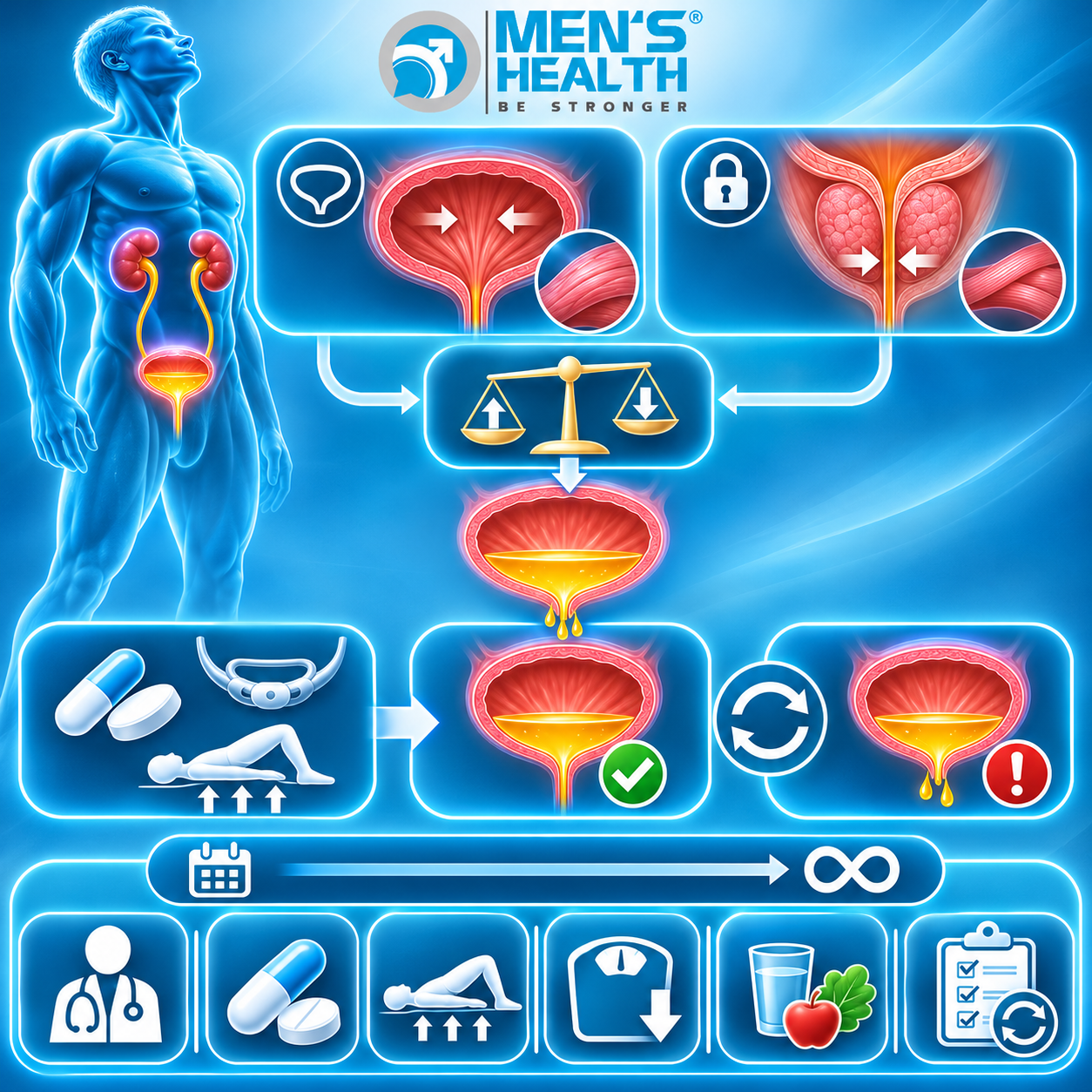
Involuntary leakage occurs through two fundamental biomechanical mechanisms:
- Intravesical Storage Pressure Exceeding Closure Resistance: Driven by involuntary, uninhibited detrusor overactivity (DO) or impaired bladder storage compliance during filling.
- Incompetent Urethral Sphincter Mechanism: Structural disruption or denervation of the internal bladder neck or external striated urethral sphincter leading to low urethral leak-point pressure during physical exertion.
2. Risk Factors and Mechanisms Driving Recurrence After Treatment
Recurrence of male urinary incontinence is defined as the return of involuntary leakage following initial successful pharmacological, behavioral, or surgical resolution. Understanding why recurrence happens requires examining specific underlying pathophysiological pathways.
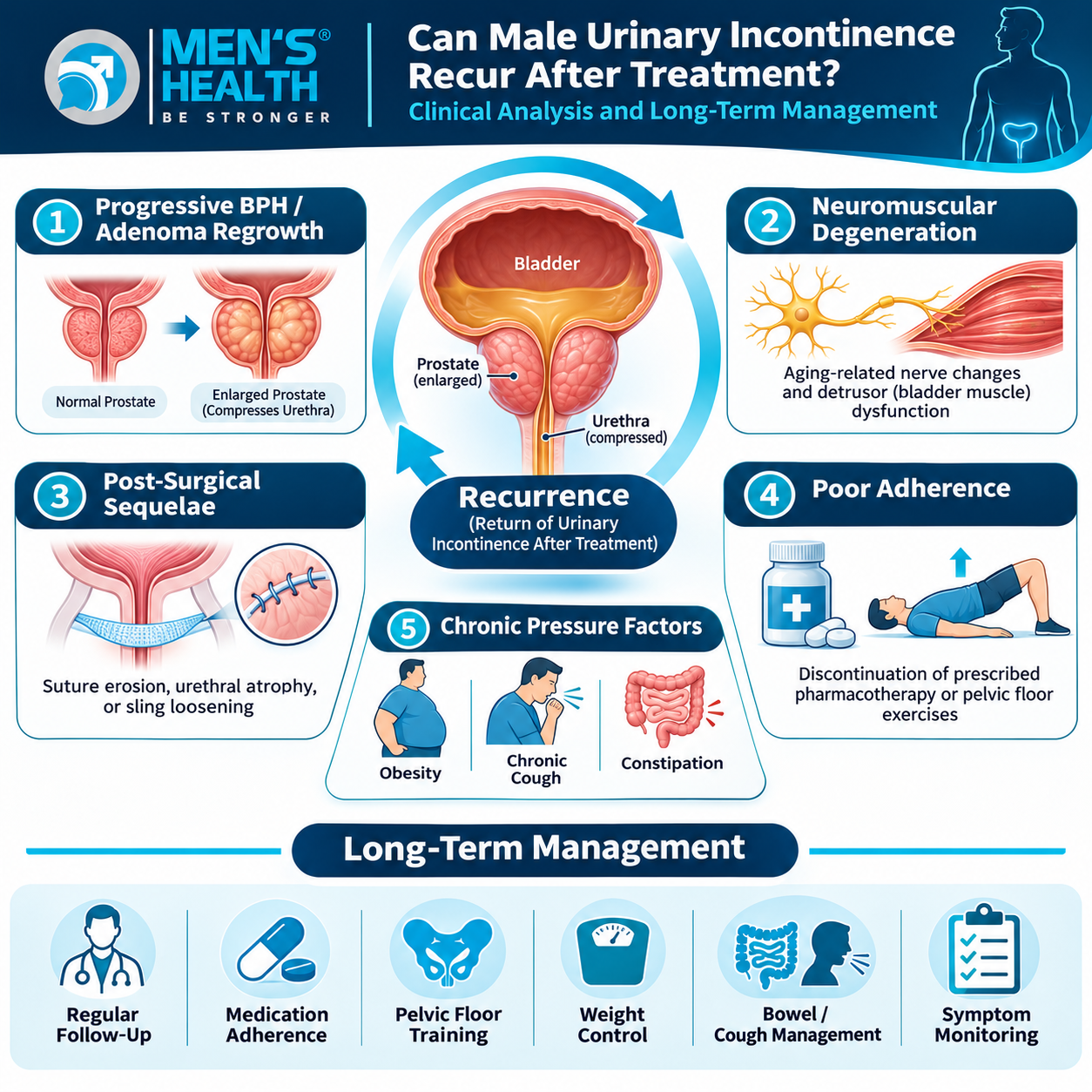
Key Mechanisms of Recurrence
- Progressive Prostatic Adenomatous Hyperplasia: Following endoscopic prostatectomy (e.g., TURP or laser ablation), remaining prostate transition zone tissue can undergo re-growth over 5–10 years, leading to recurrent bladder outlet obstruction (BOO) and secondary overflow or urgency leakage.
- Structural Urethral and Sphincteric Degradation: Post-surgical implants, such as an Artificial Urinary Sphincter (AUS) or male urethral sling, may experience mechanical tissue atrophy, fluid loss from the system, device erosion, or urethral scarring over time, leading to recurrent Stress Urinary Incontinence (SUI).
- Progressive Neurogenic Detrusor Dysfunction: Progressive neurological conditions (e.g., Parkinson’s disease, diabetic autonomic neuropathy, stroke) cause deteriorating central nervous system inhibition, resulting in persistent or recurrent Urgency Urinary Incontinence (UUI).
- Treatment Non-Adherence: Discontinuation of daily pelvic floor muscle exercises (PFMT) or stopping prescribed long-term pharmacotherapy (e.g., β3-agonists or 5-ARIs) frequently triggers symptom relapse.
3. Subtypes of Male Urinary Incontinence and Their Recurrence Risk Profile
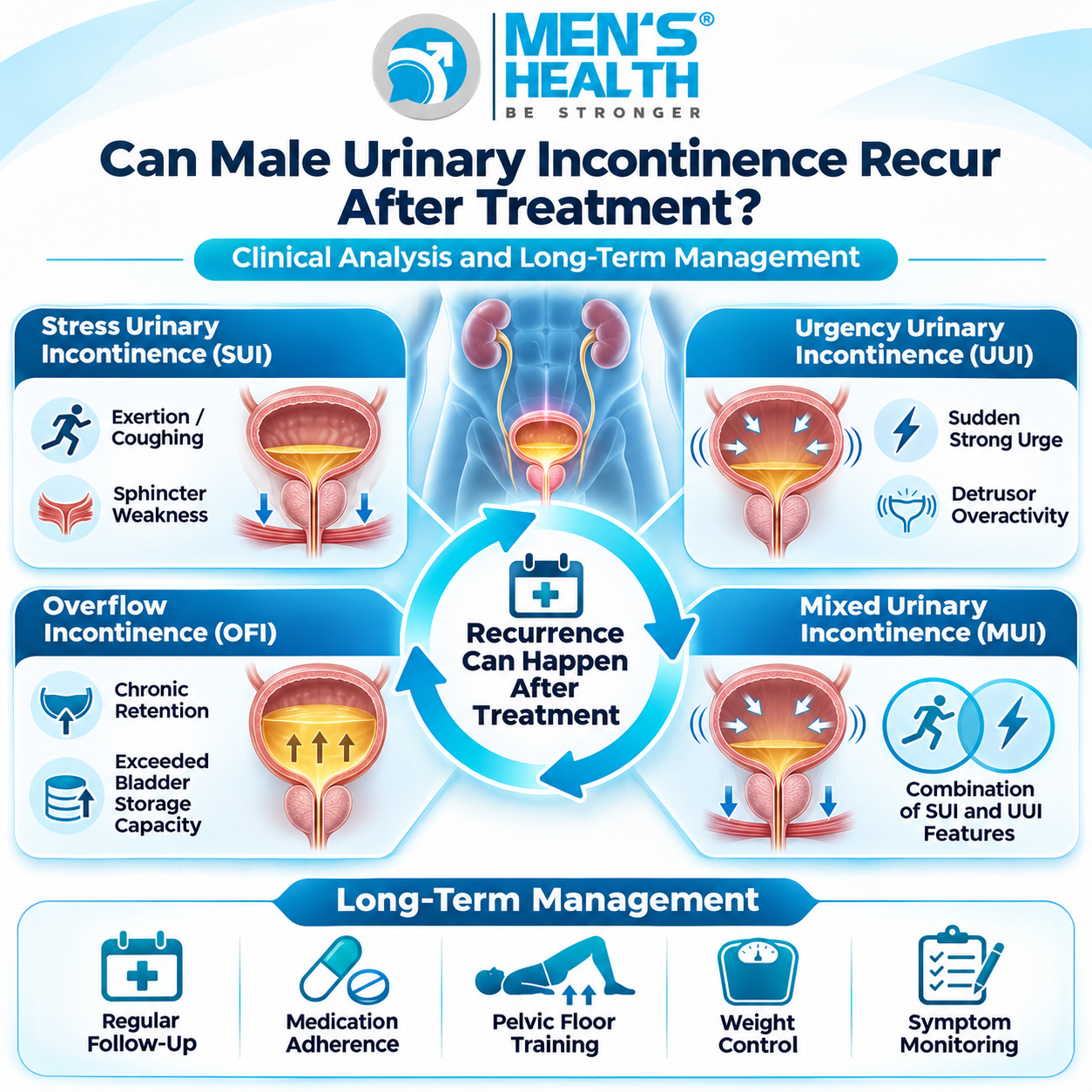
Recurrence Matrix Across Incontinence Subtypes
| Incontinence Subtype | Primary Underlying Cause | Surgical / Medical Treatment | Recurrence Risk & Mechanism |
| Stress (SUI) | External sphincter deficiency | Male Sling / Artificial Sphincter (AUS) | Moderate-High: Tissue atrophy, device wear, or mesh displacement |
| Urgency (UUI) | Detrusor overactivity (DO) | Antimuscarinics / β3-Agonists / SNM | High if medication is stopped; Moderate with age-related progression |
| Overflow (OFI) | Obstruction (BPH) / Detrusor failure | TURP / HoLEP / α1-Blockers | Moderate: Prostatic tissue re-growth or unrecovered detrusor underactivity |
| Mixed (MUI) | Dual sphincter & detrusor defect | Combination Multimodal Therapy | High: Requires dual management of storage and structural components |
4. Red Flag Symptoms Associated with Recurrent Incontinence
When urinary incontinence recurs, immediate clinical re-evaluation is necessary if accompanied by any of the following systemic red flags:
- Gross hematuria (visible blood or clots in the urine).
- Acute inability to void accompanied by severe suprapubic pain (Acute Urinary Retention).
- Systemic infectious signatures: fever, rigors, flank pain, or purulent urethral discharge.
- Rapidly progressive neurological symptoms (e.g., saddle anesthesia, lower extremity weakness).
- Severe scrotal or perineal pain in patients with synthetic sphincter or sling implants (suspected erosion or infection).
5. Diagnostic Protocol for Evaluating Recurrent Incontinence
Re-evaluating a patient with recurrent leakage requires systematic diagnostic testing to isolate anatomical failure from functional detrusor dysfunction.

- Detailed Clinical History & Voiding Diary (3-7 Days): Quantifies current daily fluid intake, voiding intervals, leakage frequency, and daily pad weight/usage count compared to post-initial-treatment baselines.
- Physical & Digital Rectal Examination (DRE): Re-evaluates prostate size and tenderness, assesses sacral reflex arcs (S2–S4), and inspects surgical incision sites or implant pumps.
- Urinalysis and Urine Culture: Essential to rule out bacterial cystitis or chronic prostatitis causing secondary temporary urgency leakage.
- Post-Void Residual (PVR) Ultrasound: Measures residual urine volume post-micturition to ensure recurrence is not driven by silent overflow retention (PVR > 150-200 mL).
- Multi-Channel Urodynamic Studies (UDS): Evaluates detrusor leak-point pressure (DLPP), filling compliance, and pressure-flow curves to differentiate recurrent detrusor overactivity from sphincteric incompetence.
- Flexible Cystourethroscopy: Direct endoscopic inspection to evaluate urethral luminal integrity, exclude recurrent urethral strictures or prostatic regrowth, and confirm artificial sphincter or sling alignment without erosion.
6. Pharmacological Management Strategies for Recurrent Incontinence
Managing recurrent incontinence requires targeted pharmacotherapy based on the verified mechanism of recurrence.

Core Drug Classes
Beta-3 Adrenoceptor Agonists
- Mechanism: Selectively activate β3-adrenergic receptors on detrusor smooth muscle cells, increasing intracellular cAMP levels and promoting storage relaxation without impairing voiding contraction.
- Agents: Mirabegron, Vibegron.
- Indications: First- or second-line therapy for recurrent Urgency Urinary Incontinence (UUI), particularly in elderly men sensitive to anticholinergic side effects.
- Adverse Effects & Precautions: Mild blood pressure elevation, tachycardia, headache. Contraindicated in severe uncontrolled hypertension.
Antimuscarinic (Anticholinergic) Agents
- Mechanism: Competitive antagonist at M2 and M3 muscarinic acetylcholine receptors, blocking parasympathetic activation of the detrusor muscle during bladder filling.
- Agents: Solifenacin, Tolterodine, Fesoterodine, Trospium.
- Indications: Recurrent UUI or refractory detrusor overactivity.
- Adverse Effects & Precautions: Dry mouth, constipation, blurred vision, cognitive decline. Contraindicated in angle-closure glaucoma and elevated PVR.
Alpha-1 Adrenoceptor Antagonists (α1-Blockers)
- Mechanism: Selectively block α1A-adrenoceptors in the prostate stroma and bladder neck, reducing smooth muscle tone and lowering outflow resistance.
- Agents: Tamsulosin, Silodosin, Alfuzosin.
- Indications: Recurrent overflow incontinence or LUTS secondary to prostatic tissue regrowth.
- Adverse Effects: Orthostatic hypotension, dizziness, retrograde ejaculation.
5-Alpha Reductase Inhibitors (5-ARIs)
- Mechanism: Block conversion of testosterone to dihydrotestosterone (DHT), inducing prostatic epithelial cell apoptosis and reducing gland volume over 3 to 6 months.
- Agents: Finasteride, Dutasteride.
- Indications: Management of recurrent prostate growth driving outflow obstruction in glands >30 mL.
- Adverse Effects: Reduced libido, erectile dysfunction, decreased baseline PSA.
Comprehensive Drug Comparison Matrix
| Class | Primary Target | Mechanism | Indication in Recurrence | Key Adverse Effects | PVR Impact |
| β3-Agonists | β3-Adrenoceptor | Promotes detrusor relaxation | Recurrent UUI | Mild hypertension, headache | Minimal / Neutral |
| Antimuscarinics | M2/M3 Receptors | Blocks involuntary contraction | Recurrent UUI | Dry mouth, constipation, cognitive load | May increase PVR |
| α1-Blockers | α1A-Adrenoceptor | Relaxes prostatic muscle tone | Recurrent BPH / Overflow | Orthostasis, retrograde ejaculation | Decreases PVR |
| 5-ARIs | 5α-Reductase | Shrinks prostate volume | Recurrent BPH growth | Low libido, erectile dysfunction | Decreases PVR long-term |
7. Procedural and Surgical Re-Intervention Strategies
When recurrent incontinence fails conservative and medical management, surgical revision options exist:
- Artificial Urinary Sphincter (AUS) Revision: Indicated for recurrent SUI due to tissue atrophy or mechanical component failure. Surgical revision involves downsizing the urethral cuff, adding fluid, or replacing the pump/balloon mechanism.
- Secondary Male Sling or Sling-to-AUS Conversion: In patients with recurrent SUI after a failed male sling, conversion to an Artificial Urinary Sphincter represents the gold-standard surgical approach.
- Sacral Neuromodulation (SNM) Reprogramming or Implantation: For refractory recurrent urgency incontinence, adjusting electrical parameters of an existing S3 neurostimulator or initiating new SNM therapy restores central micturition reflex regulation.
8. Comprehensive Clinical Care at Men’s Health Center and Men’s Health Pharmacy
Managing male urinary incontinence and addressing symptom recurrence requires precise urological diagnostics and coordinated clinical pharmacy support.
Men’s Health Pharmacy, an integral component of the Men’s Health Center ecosystem founded by Dr. Tra Anh Duy (MD, PhD, Spec. II), delivers clinical pharmacy services tailored to male urological health. Patients receive comprehensive consultations from experienced urologists and clinical pharmacists to ensure that therapeutic regimens – whether involving α1-blockers, antimuscarinics, β3-agonists, or 5-ARIs – are tailored to specific urodynamic profiles and post-treatment findings. The facility emphasizes professional safety, patient privacy, absolute confidentiality, and evidence-based practice across all stages of management and follow-up care.

9. Lifestyle Modifications and Long-Term Prevention of Recurrence
- Continuous Pelvic Floor Muscle Maintenance: Maintain long-term daily Pelvic Floor Muscle Training (PFMT/Kegels) even after symptom resolution to prevent sphincteric weakness.
- Fluid Regulation Protocols: Maintain appropriate daily hydration (1.5 – 2.0 L/day) while restricting fluids 2 to 3 hours before sleep to reduce nocturnal volume stress.
- Elimination of Urothelial Irritants: Minimize intake of caffeine, alcohol, carbonated beverages, and artificial sweeteners that irritate the detrusor muscle.
- Weight and Intra-Abdominal Pressure Management: Treat chronic constipation and maintain a healthy body mass index (BMI) to lower persistent downward pressure on the pelvic floor.
10. Common Clinical Pitfalls in Managing Recurrent Incontinence
- Empiric Treatment Without Repeat Urodynamics: Restarting antimuscarinics without measuring post-void residual urine or performing repeat urodynamic studies risks precipitating acute urinary retention in unrecognized overflow cases.
- Assuming Surgical Implants Last Indefinitely: Failing to educate patients that mechanical devices (e.g., Artificial Urinary Sphincters) have an operational lifespan of 7–10 years and may require surgical revision.
- Discontinuing Behavioral Therapy Post-Symptom Relief: Stopping pelvic floor muscle exercises once continence is achieved frequently results in gradual sphincteric decompensation and symptom relapse.
- Unsupervised Self-Medication: Relying on over-the-counter supplements or unprescribed medications without specialist guidance risks delaying treatment for progressive prostatic obstruction or neurological disease.
11. Frequently Asked Questions
Can male urinary incontinence return years after successful treatment?
Yes. Male urinary incontinence can recur years after initial treatment due to natural aging of detrusor smooth muscle, progressive prostatic tissue regrowth after prostate surgery, or wear and tissue atrophy associated with surgical implants like slings or artificial sphincters.
Why does urgency urinary incontinence recur if medication is stopped?
Pharmacological agents like β3-agonists and antimuscarinics manage detrusor overactivity by modulating receptor signaling during the storage phase; they do not permanently alter the underlying neurogenic or myogenic pathophysiology. Discontinuing medication usually results in the return of involuntary bladder contractions.
What should a man do if incontinence recurs after prostate surgery?
The patient should undergo a formal urological re-evaluation, including a voiding diary, post-void residual ultrasound, and potentially multi-channel urodynamics or cystoscopy to determine whether the recurrence is caused by sphincter weakness, detrusor overactivity, or urethral stricture disease.
Are revision surgeries effective for recurrent stress urinary incontinence?
Yes. Revision surgeries, such as adjusting or replacing components of an Artificial Urinary Sphincter (AUS) or converting a failed male sling to an AUS, have high success rates in restoring continence.
How does post-void residual (PVR) testing help when incontinence recurs?
PVR ultrasound testing determines whether the recurrent leakage is caused by bladder storage failure (e.g., urge incontinence) or bladder emptying failure (e.g., overflow retention), ensuring that inappropriate medications are avoided.
Conclusion and Expert Clinical Advice
Urinary incontinence in men can recur due to progressive physiological changes, prostate regrowth, surgical implant wear, or treatment non-adherence. Managing recurrent leakage requires a systematic clinical diagnostic pathway – including voiding diaries, residual volume scans, and urodynamics – to identify the exact pathophysiological mechanism and guide therapy safely.
Patients experiencing recurrent urinary leakage should avoid self-diagnosis or unprescribed treatment regimens. Seeking professional evaluation at a specialized urological facility such as the Men’s Health Center guarantees precise diagnostic assessment, specialist physician oversight, and dedicated clinical pharmacy support for long-term urological health.